
Paperwork is rarely the hardest part of being behind on a mortgage, but it can feel that way when a deadline is approaching and the documents you need are scattered across old mail, a lender’s website, and a filing cabinet you haven’t opened in years. Selling a property in default doesn’t require anything exotic. It requires the same core documents any California home sale needs, plus a few pieces specific to the loan being in default.
This page lays out exactly what to gather, where to get anything missing, and what can wait until escrow requests it rather than something you need on day one.
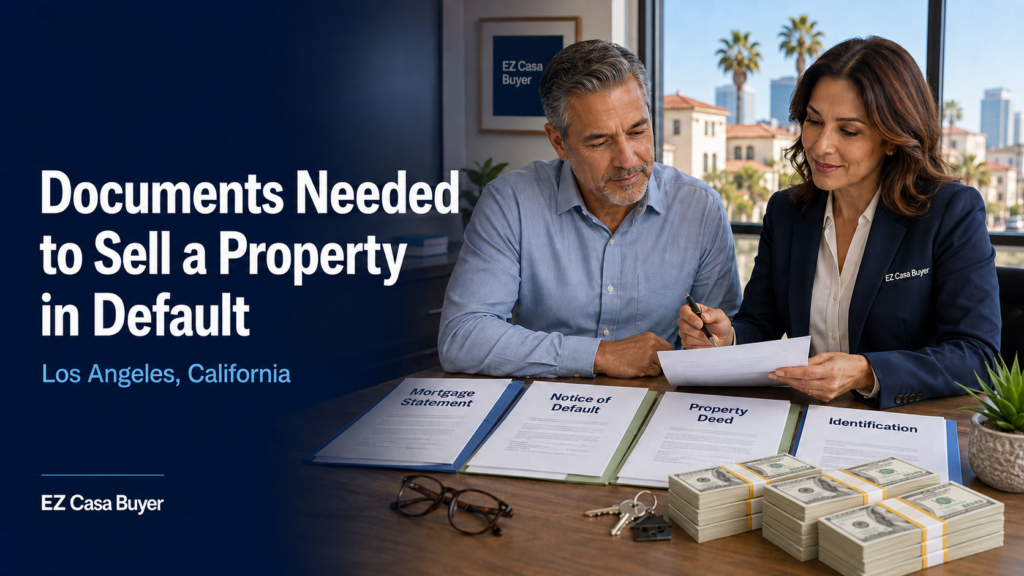
Quick answer: Selling a property in default in Los Angeles generally requires your loan and default paperwork (mortgage statement, Notice of Default, and a payoff or reinstatement figure from your servicer), standard California disclosure forms (TDS, NHD, and others depending on the property), proof of ownership, and identification. Escrow and title will request additional items as the transaction moves forward, so nothing needs to be perfect before you start.
Documents Tied to the Loan and the Default
These are specific to the fact that the loan is behind, and they’re usually the pieces owners are missing or unsure how to get.
- Current mortgage statement. Shows the loan balance, servicer contact information, and payment history.
- The recorded Notice of Default (NOD), if one has been filed. This is a public document recorded with the Los Angeles County Registrar-Recorder/County Clerk. If you don’t have your copy, the servicer that sent it or the county recorder’s office can provide it.
- A payoff demand statement. This is a formal statement from the loan servicer showing the exact amount required to pay off the loan in full as of a specific date, including any fees. Escrow requests this directly from the servicer once a sale is in progress, so you don’t need to obtain it yourself, but knowing it exists helps you understand what a sale needs to satisfy.
- A reinstatement quote, if you’re exploring curing the default instead of selling. This shows the amount needed to bring the loan current rather than pay it off entirely. It’s a different figure from the payoff amount, and it’s useful to have if you’re still weighing whether to sell or keep the property.
- Statements for any second mortgage, HELOC, or other lien holder. Any additional loans secured by the property need to be paid off or resolved through escrow as well.
- The Notice of Trustee’s Sale, if one has already been recorded. This document sets the auction date and is the clearest sign of how much time remains.
- Property tax statements, particularly if property taxes are also behind, since delinquent taxes are typically resolved through escrow at closing.
None of these need to be perfectly organized before you talk to an agent or a buyer. A servicer name, loan number, and the date on your NOD are usually enough to get the process moving while the rest is gathered.
Standard California Disclosure Documents
Being in default doesn’t remove your disclosure obligations. A voluntary sale by the current owner, even one motivated by a default, still requires the same disclosures as any other California residential sale of one to four units. (Note: this is different from the foreclosure trustee’s sale itself, which is legally exempt from the standard disclosure requirements. A voluntary sale that pays off the loan before that point is not.)
- Transfer Disclosure Statement (TDS). The core disclosure form under California Civil Code § 1102, covering known conditions of the property’s systems, structure, and any material defects.
- Seller Property Questionnaire (SPQ). A more detailed, commonly used supplement to the TDS covering repair history, insurance claims, and disputes.
- Natural Hazard Disclosure (NHD) Report. A third-party report identifying flood zones, fire hazard severity zones, earthquake fault zones, and similar mapped hazards. This is ordered through a disclosure company, not filled out by the seller.
- Lead-Based Paint Disclosure, required for any home built before 1978, along with the EPA pamphlet on lead hazards.
- Megan’s Law Database Disclosure, a standard notice included in the purchase contract.
- Mello-Roos or special tax district disclosure, if the property is subject to one.
- Death-on-property disclosure, if a death occurred at the property within the past three years, regardless of cause.
- HOA documents, if the property is a condo or part of a planned development: CC&Rs, bylaws, current budget, recent meeting minutes, and a statement of any unpaid assessments. Under Civil Code § 4525, these generally must be provided within ten days of a buyer’s request.
If you’re unsure whether a specific disclosure applies to your property, a real estate agent or transaction coordinator can confirm it based on the property’s age, location, and ownership structure.
Ownership and Identity Documents
- A government-issued photo ID, required by the title and escrow company to verify your identity.
- Proof of ownership, typically the grant deed from when you acquired the property. If you don’t have a copy, the county recorder’s office can provide one.
- A Statement of Information, a form title companies use to distinguish you from others with similar names during a title search. This is usually completed early in escrow, not something to track down in advance.
- Homeowners insurance information, including the policy and any recent claims, particularly if the property has damage that’s relevant to the sale.
Situational Documents
Some ownership situations add documents beyond the standard list.
If the property is inherited or the owner is deceased:
- A certified copy of the death certificate
- Letters Testamentary or Letters of Administration if the estate is going through probate
- An Affidavit of Death of Joint Tenant, if title passed by survivorship rather than probate
If the property is held in a trust:
- A Certification of Trust, confirming the trustee’s authority to sell
If the sale follows a divorce:
- The relevant portion of the divorce judgment or settlement agreement addressing the property
If someone else is signing on your behalf:
- A valid, property-specific power of attorney
If you are a foreign seller:
- Documentation related to FIRPTA withholding requirements, which your escrow or title company can walk you through
None of these situations prevent a sale. They typically just mean escrow will ask for one or two extra documents beyond the standard list.
What Escrow and Title Actually Need Directly From You
Not every document on this page needs to come from you personally. Once escrow opens:
- The title company orders the preliminary title report and identifies any liens, including the mortgage in default, on its own.
- The loan servicer provides the official payoff demand directly to escrow, not to you.
- The disclosure company provides the NHD report once ordered.
- You’re primarily responsible for: the TDS, SPQ, your ID, proof of ownership if requested, HOA contact information if applicable, and honest answers about the property’s condition and history.
This division of labor is worth knowing, since it means a missing payoff statement or title report isn’t something you need to chase down yourself before starting the process.
How This Works With a Default Timeline
If a Notice of Default Los Angeles has already been recorded, the reinstatement period is generally 90 days before a Notice of Trustee’s Sale can follow, with additional weeks of notice after that before an auction. Gathering documents doesn’t need to happen all at once or before you start talking with an agent or a buyer:
| When | What Matters Most |
|---|---|
| Before choosing a selling path | Loan balance, NOD date, and whether a second mortgage or lien exists |
| Once you decide to sell | TDS, SPQ, and ownership documents, since these are yours to complete |
| Once escrow opens | Title report and payoff demand, both ordered by escrow and the title company |
| Before closing | Any situational documents (probate, trust, divorce) confirmed and finalized |
Starting the process with an incomplete file is normal. What matters is starting it early enough that the remaining pieces can be gathered before a scheduled trustee’s sale date.
How EZ Casa Buyer Can Help
If gathering every disclosure form and loan document feels like one more obstacle on top of an already stressful situation, we can walk through what’s actually needed for your specific property rather than handing you a generic list.
- Tell us about the property and where things stand with the loan and any default notices.
- We help identify what’s already on hand and what still needs to be requested, from the servicer or the county recorder.
- We prepare an offer based on the property and situation as they stand today.
- If you move forward, our team and the title company handle ordering the payoff demand and title report directly.
- Closing is coordinated around your actual deadline.
We don’t expect a complete file before the first conversation. Most owners start with far less paperwork in hand than they think they need.
[Tell Us About Your Property]
Frequently Asked Questions
What’s the most important document I need if I’m behind on my mortgage and want to sell? Your current mortgage statement and, if one has been recorded, your Notice of Default. Together they establish the loan balance and the timeline you’re working with.
What is a payoff demand statement, and do I need to get it myself? It’s a formal statement from your loan servicer showing the exact amount needed to pay off the loan by a specific date. Escrow requests this directly from the servicer once a sale is underway, so you don’t need to obtain it in advance.
I lost my copy of the Notice of Default. How do I get another one? The Los Angeles County Registrar-Recorder/County Clerk’s office maintains public records of recorded documents, including a Notice of Default, and can provide a copy. Your loan servicer can also usually resend it.
Do I still need to complete disclosure forms if I’m selling because of financial hardship? Yes. Disclosure obligations under California law apply regardless of the reason for the sale. The only exemption is the foreclosure trustee’s sale itself, which is a different transaction than a voluntary sale.
What if the property was inherited and I don’t have all the original documents? A death certificate and, if applicable, probate documents (Letters Testamentary or Letters of Administration) generally fill in what’s needed. The county recorder can also provide a copy of the original grant deed if it’s missing.
Can I start the selling process before I have everything gathered? Yes. Most of the paperwork, including the title report and payoff demand, is ordered by escrow and the title company once a sale begins. What you need upfront is mainly your loan information and basic ownership documents.
Do I need a lawyer to help with the paperwork? Not for a standard sale, though a real estate attorney is worth involving if the situation includes probate complications, a disputed title, unresolved liens, or anything you’re unsure how to disclose.
What happens if I can’t get a document in time before a trustee’s sale date? Talk to whoever is handling your sale as early as possible. Missing paperwork is common and usually solvable, but it takes longer to resolve the closer you get to a scheduled auction date.
Where to Go From Here
Gathering paperwork while dealing with a default is rarely anyone’s idea of a good use of time, but it’s usually more straightforward than it looks from the outside. If you’re not sure what you already have or what’s still needed for your specific property, we’re glad to help sort through it.
What If You Cannot Catch Up on Your Mortgage?
If the amount needed to bring your mortgage current is more than you can afford, it may be time to explore alternatives. Homeowners behind on mortgage payments can review possible lender solutions, property equity, and selling options before foreclosure becomes more advanced.
Can You Sell a House With Late Mortgage Payments?
Late mortgage payments do not automatically prevent a property sale. The important question is whether the sale can cover the mortgage payoff and other obligations. If you are behind on mortgage payments, getting accurate payoff and property value information can help you understand your position.