
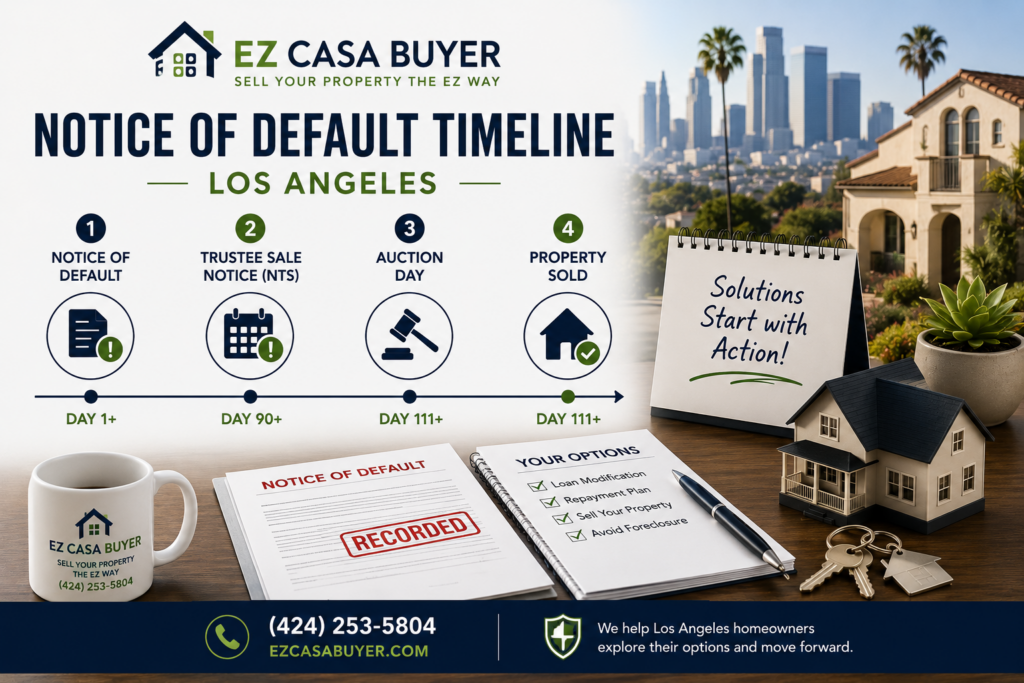
A Notice of Default Los Angeles doesn’t mean your home sells next week. It means a formal countdown has started, and California law gives you a specific window to fix the default, sell the property, or plan your next move before a trustee sale can happen.
If a Notice of Default was just recorded against your Los Angeles County home, here’s the direct answer: you generally have at least 90 days from the recording date to cure the default before your lender can even schedule a sale, and at least another 20 days after that before the sale can occur. In practice, most Los Angeles homeowners have three to five months or more once every legal notice period is factored in, and newer state law can extend that further if you list the home for sale.
Below is the full breakdown of what happens after an NOD, what your rights are during each stage, and what your realistic options look like at each point.
Quick Answer: The Minimum Timeline
- 90 days from the recorded Notice of Default before your lender can record a Los Angeles Notice of Trustee’s Sale (Civil Code 2924).
- At least 20 more days after the Notice of Trustee’s Sale is recorded, posted, and published before the auction can happen.
- Roughly 110 days minimum total from NOD to sale date, though most cases run longer once mailing, posting, and publication requirements stack up.
- Up to 45 additional days, twice, if you list the property with a licensed California broker and later sign a purchase agreement, under Assembly Bill 2424.
Now let’s walk through what each stage actually means for you.
What Happens Before the Notice of Default Even Gets Filed
Most Los Angeles homeowners don’t receive an NOD after a single missed payment. Federal mortgage servicing rules generally require a loan to be at least 120 days delinquent before a servicer can start the foreclosure process, and many lenders attempt contact, offer a repayment plan, or open a loss mitigation review before recording anything with the county.
Under California’s Homeowner Bill of Rights, your servicer is also required to:
- Assign a single point of contact once you request loss mitigation help
- Review a complete loan modification application before proceeding with foreclosure
- Avoid “dual tracking,” meaning they generally cannot record a Notice of Trustee’s Sale while your completed application is still under review
If you missed payments and never heard from your lender about options, that’s worth raising directly with them or with a HUD-approved housing counselor before assuming nothing can be done.
Day Zero: The Notice of Default Is Recorded
The Notice of Default is recorded with the Los Angeles County Recorder’s Office and mailed to you, usually by certified mail. This is a public record, which is why direct buyers, agents, and attorneys sometimes reach out shortly after it posts.
The NOD states the amount needed to bring the loan current. This is not the full loan balance. Reinstating a defaulted mortgage means paying the missed payments, late fees, and any legal costs the lender has incurred, not the entire remaining loan.
Days 1–90: The Reinstatement Period
For at least 90 days after the NOD is recorded, you have the right to cure the default and reinstate the loan under California Civil Code 2924. During this window, you can typically:
- Pay the past-due amount in full and resume normal payments
- Apply for a loan modification or repayment plan through your servicer
- List the home for sale on the open market
- Negotiate a short sale if the home is worth less than what’s owed
- Explore selling directly to a buyer who can close before the deadline
- Do nothing, which allows the process to continue toward a Notice of Trustee’s Sale
This 90-day period is a floor, not a ceiling. Lenders sometimes take longer to move to the next stage, especially if you’re actively working with them on a modification or your file is under review.
Day 90 and Beyond: The Notice of Trustee’s Sale
If the default isn’t cured, the lender’s trustee can record a Notice of Trustee’s Sale (NOTS) once at least three months and 20 days have passed since the NOD was recorded. This notice sets the actual auction date and must be:
- Recorded with the county recorder
- Posted on the property
- Posted in a public place in the city or county where the sale will occur
- Published once a week for three consecutive weeks in a local newspaper
- Mailed to you directly
State law requires at least 20 days between the recording of the Notice of Trustee’s Sale and the auction date itself. In Los Angeles, publication and posting requirements often push this closer to three or four weeks in practice.
Once the auction date is set, reinstatement rights don’t disappear immediately. Depending on your loan documents and how far along the sale process is, you may still be able to reinstate or pay off the loan up until shortly before the sale. A title company, escrow officer, or attorney can confirm the exact cutoff for your loan.
AB 2424: A Newer Way to Buy More Time
Since January 1, 2025, California homeowners facing non-judicial foreclosure have had a tool that didn’t exist a few years ago. Under Assembly Bill 2424, if you submit a valid listing agreement with a licensed California real estate broker at least five business days before your scheduled sale date, the trustee is required to postpone the sale for at least 45 days so the home can be marketed for sale.
If you later sign a purchase agreement during that window and submit it at least five business days before the rescheduled sale, the trustee must postpone the sale again, by at least another 45 days, to allow the transaction time to close.
This law applies to first mortgages on residential properties of up to four units and is currently set to remain in effect through January 1, 2031. It gives homeowners a real, legally protected path to sell the property on their own terms instead of losing it at auction, as long as the listing and any resulting sale are handled correctly and on time.
A related protection, tied to Civil Code 2924m, also limits how low a winning bid can be at the first scheduled auction for many owner-occupied and small residential properties, which is meant to preserve more of an owner’s equity if the home does reach the courthouse steps.
What This Timeline Looks Like Added Together
For a typical Los Angeles single-family home with a first mortgage:
- 120 or more days of missed payments before an NOD is even recorded, in most cases
- 90 days minimum from the NOD before a Notice of Trustee’s Sale can be recorded
- 20 or more days from the Notice of Trustee’s Sale to the auction date
- Up to 90 additional days combined if AB 2424’s listing and purchase agreement postponements are used
Added together, most Los Angeles homeowners have somewhere between three and ten months from the first missed payment to an actual auction date, and the reinstatement and listing options above are available for much of that window, not just the first few days.
Your Main Options While the Clock Is Running
Reinstating or modifying the loan. If your income has recovered or you can bring the loan current, this keeps the home and the existing mortgage terms intact. It requires having or arranging the funds, or a servicer willing to modify the loan.
Listing the property on the open market. This can work well if there’s enough equity and time to complete a traditional sale, and AB 2424 now gives you a structured way to protect that timeline once you’re close to a scheduled sale.
Selling directly to a buyer. Selling to a direct buyer, without listing, showings, or repairs, can make sense when time is short, the property needs work you can’t afford to do, or a straightforward closing matters more than testing the open market for top dollar. This isn’t always the option that nets the most money, and it isn’t the right fit for every owner. It tends to make the most sense when speed and certainty matter more than maximizing the sale price.
Short sale. If the loan balance exceeds the home’s value, a short sale negotiated with your lender may be possible, though it requires lender approval and can take time you may not have if the auction date is close.
Doing nothing. This is always an option, but it’s the one that removes your ability to control the outcome. Once the property reaches auction, you generally lose the ability to negotiate terms, and any equity above the winning bid isn’t guaranteed to you without separately following the excess proceeds claim process through the county.
How EZ Casa Buyer May Be Able to Help
We work with Los Angeles County property owners who are somewhere in this timeline, whether the NOD was recorded last week or the trustee sale date is already set. We look at the property’s condition, any liens or unpaid amounts, and how much time is actually left before making an offer, so you’re working from real numbers instead of guesses.
We don’t require repairs, cleaning, or a specific move-out date before making an offer, and a direct sale can sometimes close faster than the remaining time on the foreclosure clock. That said, a direct sale isn’t automatically the right move for every owner in default. If listing the home or reinstating the loan makes more sense for your situation, we’ll say so.
Frequently Asked Questions
Does a Notice of Default mean I’ve lost my home? No. It means a formal default has been recorded and a countdown has started. You still have reinstatement rights and, in most cases, months before an auction could happen.
Can I sell my house after receiving a Notice of Default? Yes. You can list the home, sell it directly, or pursue a short sale during the reinstatement period and often up until close to the scheduled auction date, as long as the sale closes in time to pay off the loan.
How much do I need to pay to stop the foreclosure? To reinstate, you typically need to pay the past-due payments, late fees, and related costs stated in the notice, not the entire loan balance. Paying off the loan in full is a separate option and is usually only required if you’re past the reinstatement deadline.
What is the difference between a Notice of Default and a Notice of Trustee’s Sale? The Notice of Default starts the 90-day reinstatement period. The Notice of Trustee’s Sale comes later, sets the actual auction date, and can only be recorded after that 90-day period has passed without the default being cured.
Can listing my house delay the sale date? Yes, under Assembly Bill 2424, submitting a valid listing agreement with a licensed broker before your scheduled sale date can require the trustee to postpone the auction by at least 45 days, with a possible additional 45-day postponement if you sign a purchase agreement.
What happens to my equity if the home goes to auction? If the winning bid exceeds what’s owed, you may be entitled to claim the excess proceeds, but this typically requires filing a claim with the county and isn’t automatic. Selling before the auction date is generally the more direct way to access that equity yourself.
Can I still get a loan modification after an NOD is recorded? Often, yes. California’s Homeowner Bill of Rights generally requires servicers to review a complete modification application before continuing toward a sale, though timing and eligibility depend on your specific loan and servicer.
Do these timelines apply to rental and inherited properties? The core Civil Code timelines apply to non-judicial foreclosures generally, though AB 2424’s postponement rights are specific to first mortgages on properties of up to four units. An inherited property already in default may also involve probate steps that affect who has authority to act, which is worth confirming with an attorney.
Should I talk to an attorney or housing counselor before deciding? It’s reasonable to. A real estate attorney or HUD-approved housing counselor can confirm exact deadlines for your loan, review your servicer’s compliance with notice requirements, and explain how any of these options apply to your specific paperwork.
What to Do Next
If you’re holding a Notice of Default right now, the most useful next step is figuring out exactly where you are in this timeline and what realistic options are still open, whether that’s reinstating, listing, or selling directly. We’re glad to look at your specific situation and lay out what we see, with no pressure either way.
Tell Us About Your Property to get a clear picture of your options, or Call Ryan to Discuss Your Situation if you’d rather talk it through first.
What If Your House Has Multiple Liens?
Second mortgages, HELOCs, judgments, tax liens, and other obligations can complicate a property sale. Homeowners behind on mortgage payments should identify liens as early as possible so they have a clearer understanding of what may need to be resolved through escrow.
Can a Cash Buyer Help Before Foreclosure?
A direct property sale may be an option for homeowners who prioritize speed and do not want to make repairs or prepare their house for traditional showings. If you are behind on mortgage payments, compare any cash offer with your payoff, equity, timeline, and other available alternatives before deciding.