
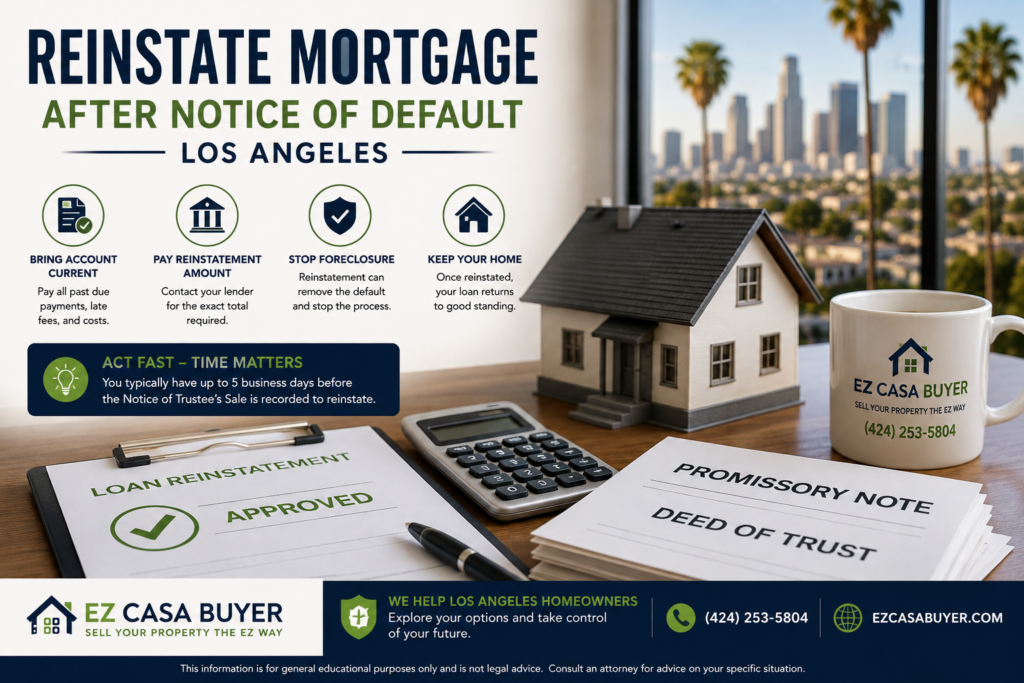
If a Notice of Default Los Angeles just showed up attached to your door or arrived in the mail, the first question is usually the same: is the house already gone? It isn’t. A Notice of Default (NOD) starts the foreclosure clock in Los Angeles County, but it also opens a legal window to fix the default and keep the property. California law calls this reinstatement, and it’s different from paying off the entire loan.
This guide walks through what reinstatement means, how long you actually have, what it tends to cost, and what else is worth considering if reinstating isn’t realistic.
The Quick Answer
Yes. Under California Civil Code § 2924c, you generally have the right to reinstate your loan at any point from the day the Notice of Default is recorded until five business days before the scheduled trustee’s sale. Reinstating means paying the missed payments, late charges, and permitted fees, not the full loan balance. Once the lender is paid current, the foreclosure is called off and the loan continues as before.
That right has a hard stop. Once the property is inside that final five-business-day window before the sale, reinstatement is no longer guaranteed by law, though a lender can still agree to accept a cure voluntarily.
What a Notice of Default Actually Means
A Notice of Default is a document the loan servicer records with the Los Angeles County Recorder after a borrower falls significantly behind, usually around three missed payments. It’s a formal declaration that the loan is in default and that the lender intends to move toward a non-judicial foreclosure sale if the default isn’t cured.
Before recording it, the servicer is generally required to try to contact the borrower about foreclosure prevention options. Once the NOD is recorded, a copy is mailed to the borrower, and it becomes public record, which is why LA homeowners sometimes hear from investors or “buy your house” companies shortly after.
Getting the notice is serious, but it is a starting point in a process with real steps and real timelines, not an immediate deadline.
Reinstatement vs. Payoff: Know the Difference
These two terms get confused often, and the difference matters.
- Reinstatement means paying only the past-due amount: missed payments, late fees, and the servicer’s permitted costs for handling the default. The loan itself continues at its original terms.
- Payoff means paying the entire remaining loan balance in full, which is what happens if the home is sold or refinanced.
Reinstating is usually far more realistic for a homeowner who fell behind temporarily and can now afford ongoing payments. It solves the default without requiring the borrower to come up with the full loan amount.
How Much Time You Actually Have
The Los Angeles foreclosure timeline runs on fixed steps set by California law, and reinstatement stays open through most of it.
- Notice of Default is recorded. This starts the clock.
- At least three months must pass before a Notice of Trustee’s Sale can be recorded. During this period, reinstatement is fully available.
- Notice of Trustee’s Sale is recorded and posted, setting an actual sale date. California law requires this notice at least 20 days before the sale.
- Reinstatement remains available all the way through this period, right up until five business days before the sale date set in that notice.
- The trustee’s sale takes place on the scheduled date, unless it’s postponed or the default has been cured.
In practice, that means a homeowner in LA County typically has a minimum of about three to four months from the recording of the NOD before a sale can legally happen, and the right to reinstate lasts through nearly all of it. If a sale date gets postponed, which happens often, the window can stretch even further.
Once the sale date arrives and the account is inside the last five business days before it, the guaranteed legal right to reinstate ends. A lender may still agree to accept payment even inside that window, but at that point, it’s a discretionary accommodation, not a legal entitlement.
What Reinstatement Costs
Reinstating means covering the arrears, not the whole loan. That typically includes:
- All missed monthly payments
- Late charges accumulated during the delinquency
- Any property taxes or insurance the servicer advanced on the borrower’s behalf
- Foreclosure-related costs the servicer is permitted to charge, such as recording fees and trustee fees
The servicer is required to provide a written reinstatement quote showing the exact figure and how it was calculated. It’s worth requesting this in writing rather than estimating, since amounts change as more fees accrue.
Once the account is brought current and the fees are paid, the servicer must record a notice canceling the default, generally within a matter of weeks, and the loan continues on its original schedule.
Protections California Law Gives You Before a Sale
California’s Homeowner Bill of Rights adds several protections that apply during this window:
- A single point of contact. If you apply for a loan modification or other alternative, the servicer must assign a specific person or team who knows your file and can answer questions about where things stand.
- No dual tracking. If you submit a complete application for a loan modification or other foreclosure prevention option before a sale is scheduled, the servicer generally cannot move forward with recording a notice of sale or conducting the sale while that application is under review.
- A right to know why you were denied. If a servicer turns down a modification, it has to explain the reason.
These protections don’t erase the default, but they’re worth knowing about if you’re actively trying to work something out rather than pay the full arrears at once.
If Reinstating Isn’t Realistic
Not every homeowner facing a Notice of Default can pull together the full arrears in a lump sum, and that’s common. A few other paths are worth honestly weighing:
Loan modification. The servicer restructures the loan, sometimes by adding missed payments to the balance, adjusting the rate, or extending the term, so the ongoing payment becomes affordable again.
Repayment plan. The arrears get spread out over several months on top of the regular payment, rather than paid all at once.
Forbearance. Payments are paused or reduced temporarily, usually tied to a specific hardship, with a plan to catch up afterward.
Selling the property. If keeping the home no longer makes financial sense, whether because of the size of the arrears, the condition of the property, or a change in circumstances, selling before the trustee’s sale date can preserve any remaining equity that a foreclosure would otherwise wipe out. That can mean listing the property in the traditional market, or working with a direct buyer if there’s a repair, tenant, or title issue that makes a fast, as-is sale more practical.
None of these paths is automatically the right one. The best option depends on how much equity is in the property, whether the income supporting the mortgage has recovered, and how much time is left before the scheduled sale date.
How EZ Casa Buyer Can Help
For homeowners who’ve looked at the arrears, the ongoing payment, and the property itself and decided that selling makes more sense than reinstating, we work directly with property owners across Los Angeles and the surrounding Southern California counties.
We look at properties in a range of conditions, including homes already in default, homes that need repair work the owner can’t take on right now, and properties with title or lien issues that would complicate a traditional listing. We’re not able to buy every property, and a direct sale isn’t the right fit for every owner. Where it does make sense, the process typically looks like this:
- Tell us about the property and where things stand with the loan.
- We review the situation and may request more information or inspect the property.
- If it fits what we’re able to purchase, we put together an offer based on the property’s current condition.
- You review the offer without pressure and decide whether it makes sense.
- If you accept, we move through escrow, with a closing date coordinated around the foreclosure timeline.
What we’re able to offer depends on factors like the property’s condition, location, any liens or code issues, and how much time is left before a scheduled sale. We’ll walk through those factors honestly rather than promise a number before we’ve looked at the property.
Reinstating vs. Selling: A Side-by-Side Look
| Reinstating the Loan | Selling the Property | |
|---|---|---|
| What it requires | Paying arrears, fees, and costs in full (or an approved plan) | Finding a buyer and closing before the sale date |
| Best fit for | Owners whose income has recovered and who want to keep the home | Owners who can’t cover the arrears or no longer want the property |
| Effect on credit | Stops further default reporting once current | Can avoid a completed foreclosure on the credit file |
| Timeline pressure | Must be done before the reinstatement cutoff | Must close before the scheduled trustee’s sale |
| Equity | Preserved, loan continues | Preserved through sale proceeds, if any equity exists |
Frequently Asked Questions
Can I reinstate my mortgage after a Notice of Default in Los Angeles? Generally, yes. California law allows reinstatement from the date the Notice of Default is recorded until five business days before the scheduled trustee’s sale.
How much does it cost to reinstate a loan? It’s the total of missed payments, late fees, and permitted servicer costs, not the full loan balance. The servicer must provide a written reinstatement quote.
What’s the difference between reinstating and paying off my loan? Reinstating brings the account current and the loan continues. Paying off means satisfying the entire remaining balance, which typically happens through a sale or refinance.
How long do I have before the house can be sold? At minimum, a Notice of Trustee’s Sale can’t be recorded until about three months after the Notice of Default, and the sale itself must be noticed at least 20 days in advance. Reinstatement stays available through nearly all of that period.
Can the lender refuse to let me reinstate? Within the legal reinstatement period, the right generally applies as long as the required amount is paid. After that window closes, accepting a cure becomes the lender’s discretion.
Does applying for a loan modification stop the foreclosure? If a complete application is submitted before the sale is scheduled, California’s dual tracking rules generally require the servicer to hold off on key foreclosure steps while it’s under review.
What happens if I can’t come up with the full reinstatement amount? A loan modification, repayment plan, or forbearance may bring the ongoing payment back into reach. If none of those work, selling before the sale date can still preserve equity that a completed foreclosure would eliminate.
Can I sell the property instead of reinstating? Yes. Selling before the scheduled trustee’s sale, either through a traditional listing or a direct sale, is a common alternative when reinstating the full arrears isn’t realistic.
Does a Notice of Default mean I’ve lost the house? No. It starts a legal process with defined steps and a real cure period. Many homeowners reinstate, work out a modification, or sell before a sale ever takes place.
Should I talk to an attorney? A real estate attorney or a HUD-approved housing counselor can review your specific notice, loan documents, and timeline, since exact deadlines and amounts depend on your servicer and loan terms.
Where This Leaves You
A Notice of Default starts a countdown, but it’s a countdown with real time on it, and California law gives Los Angeles homeowners a genuine path to fix the default and keep the property. Whether reinstating, working out a modification, or selling makes the most sense depends on the numbers: what’s owed, what’s coming in, and how much time is left before the sale date on file.
If you’d rather talk through the property and the timeline with someone directly, tell us about your situation and we’ll walk through the options with you, honestly and without pressure.
What Should You Do When You Cannot Afford Your Mortgage?
If your mortgage has become unaffordable, ignoring the problem can reduce the amount of time available to explore solutions. Homeowners who are behind on mortgage payments should contact their servicer, review their finances, determine their property equity, and investigate all realistic options.
Can You Sell an Inherited Property With a Mortgage?
An inherited property may come with an existing mortgage, repairs, taxes, liens, or other expenses. If mortgage payments are becoming difficult to maintain, heirs should understand the estate and title situation before selling. This is especially important when the property is already behind on mortgage payments.
What Happens If You Ignore a Notice of Default?
Ignoring foreclosure notices can allow the process to continue while available time becomes shorter. If you are behind on mortgage payments, read every notice you receive, communicate with your mortgage servicer, and understand the important dates affecting your property.
How Long Does Foreclosure Take in California?
California’s nonjudicial foreclosure process involves several required stages rather than happening overnight. However, homeowners should not treat those timelines as extra time to ignore the problem. If you are behind on mortgage payments, acting early generally provides more time to evaluate possible solutions.